Few people in the state of Michigan are better-suited to talk about community college leadership than Steve Robinson, the president of Lansing Community College. Robinson has been president of LCC since 2020. Prior to that, he was president of Owens Community College in Ohio, and he also served as a dean at Mott Community College for seven years.
Robinson doesn’t address Mott’s board specifically in two posts he wrote on LinkedIn over the weekend, but it’s clear he was writing with them in mind.
Consider the relatively-new college president in Michigan who brought his deep commitment to student success in athletics to a struggling small rural college in our state. Through his vision and commitment, enrollment and student engagement are up through a redesign he brought with him from experience gained in Louisiana. In addition to transforming that college, he inspires all of us with the power that community college athletics can have to drive improvement in enrollment and student achievement. Or look at the early accomplishments of the CEO of one of our state’s flagship community colleges, an individual who learned our craft leading colleges in Indiana and Utah prior to joining us here in Michigan. The differences in state government, policy, and funding formulas have allowed this leader to help us re-frame our thinking about this important work in Michigan. Look north to the Upper Peninsula, where one of our very important community colleges had very big shoes to fill when their beloved long-term president announced her retirement. That college’s new and innovative leader came from nearby Minnesota, bringing with her a rich and innovative set of experiences for how this very difficult job is performed in a different (but culturally-adjacent) part of the country. Another one of our incredible community colleges is led by a CEO who gained his experiences in Maryland, placing student success and equity at the center of our important community college work. With the support of his board and community, this leader has singlehandedly organized community college presidents from across the country to protect and defend our student success work from political attack, placing Michigan at the center of this important project. One of our state’s longest serving community college presidents still draws on his previous tenure in Iowa and Kansas, sharing these insights from outside of Michigan after more than 20 years of leadership here in Michigan. I could go on. Many other Michigan community college CEOs spent substantial portions of their careers in other states; as a group, we greatly benefit from these experiences, which also return value to the colleges each of them serves.
Another post, “Why Colleges Shouldn’t DIY the Search for President,” is extremely relevant based on Mott’s board deciding to form their own search and hiring committee rather than relying on the expertise of a search firm that specializes in finding executive talent in higher ed. Robinson writes:
A DIY search process for the college’s top job can send up a variety of red flags for aspiring presidents, especially if the calendar of that search appears truncated or rushed. A third-party search firm adds credibility to a search in ways that might not occur to individuals who have not been through one. Think about this process from the perspective of an aspiring president. Early on, candidates for college presidencies have all kinds of questions about the college and its context that are not in the candidate and institutional profile. In fact, the information potential CEOs want most is probably not in the official documents about the search. What are the current obstacles, barriers, and shortcomings of the college? Is there turmoil, strife, or controversy lurking under the surface? What kind of candidate is the college really looking for? Are there difficult decisions that need to be made by the next CEO? Veteran consultants who do this all the time are much better at answering these questions with candor. Further, it is far more comfortable for a presidential candidate to ask these questions of a neutral third party. Remember: for the candidate in a presidential search, everyone at the college is either a potential subordinate (including the HR folks handling the details), or a member of the college’s governing board (and therefore the candidate’s new boss). Interfacing with an external firm in the early stages of the process is far better for all concerned.
Not that Mott’s board is in any way moved by facts, experience, or rational approaches to college leadership, but both of Robinson’s posts are insightful. Clearly, the chaos being inflicted on Mott by its board has the attention of the wider community college landscape in Michigan.
In a meeting featuring a parade of infuriatingly poor governance by the Mott Community College Board of Trustees on Sept. 13, Board Chair Andy Everman’s taunts to the audience were not as damaging as the things he actually voted for, but they were still ultra annoying.
I was happy to see that ABC 12 covered his continued unprofessionalism. During a particularly contentious part of the meeting, voters in attendance were audibly frustrated. They were also mocking the pre-ordained ‘yes’ votes for their presidential search plan, which seemed to be pre-planned, by saying ‘yes’ before each trustee voted. Everman called them ‘the peanut gallery’ and also added ‘your vote doesn’t count.’
Not that he needed to say that, considering the only consistent thing about his leadership as board chair has been how little he cares what any student, faculty or staff member, or member of the community has to say.
Just a reminder that voters DO get to have a say on the future of Everman and Jeffrey Swanson’s tenures on this board on November 5.
During an interview with NBC 25 after a Sept. 13 Mott Community College Board of Trustees meeting, chair Andy Everman provided this explanation for why the Board of Trustees decided to appoint its own internal ad-hoc committee to hire a permanent president rather than use the typical step of hiring a search firm that specializes in finding candidates for executive level positions in higher education:
“The board looked at the prices for that, and we’re concerned about how much it costs to do that, and they want to try it in house with our HR department, our resources at the college, our board attorney, our members looking through that,” Everman said.
Well, let’s consult the tape. At about the 27:36 minute mark at that meeting, Trustee Jeffrey Swanson and Everman both indicate that they don’t even know how much it would cost to hire a search firm.
“How pricey are these (firms)?” Swanson asks.
“We don’t know, when you go through each one of them (the proposals), they did not give us a price,” Everman responds.
At about the 28:08 mark, Swanson then makes a motion to not use any of the search firms and instead establish an ad-hoc committee to do the search. At the point the motion is made, both Everman and Swanson have publicly said they don’t even know what the costs would be to use a firm.
At the 30-minute mark, Mott Assistant Vice President of Human Resources Kristi Dawley is allowed to address the board. She points out that the firms did, in fact, provide cost estimates in their proposals in the packets in front of board members. Everman and Swanson either both missed that, or both didn’t even review the proposals before deciding to use an ad-hoc committee. The absolute most generous I can be here would be to suggest that Everman and Swanson may have both quickly skimmed the costs after it was pointed out to them the information was in their packets, so I guess they technically could’ve glanced at the prices in the minute or two between acknowledging they didn’t know and voting on a motion. But both CLEARLY had no idea what a search firm even costs before a motion was made and supported, so to suggest that the board made this decision based on their worries about “cost” is not credible when that wasn’t even information at least two of the four trustees who voted for this cared to find out or discuss publicly. This is another decision that appears to have been made before the public meeting even took place.
The Mott Community College Board of Trustees held a special meeting on Friday, Sept. 13, to discuss the search process for hiring a permanent president. Like most Mott board meetings, it quickly devolved into confusion and controversy. Among the decisions made:
For at least the second time since July, the board voted to move public comment on the agenda until after decisions had been made so that the public wouldn’t have a chance to weigh in first (incidentally, approximately 20 people eventually spoke during public comment and none expressed support for the board’s actions);
The board decided to eschew using a professional search firm that specializes in higher education executive talent;
The board created an ad-hoc committee to oversee the search;
The board appointed Andy Everman, John Daly, and Jeffrey Swanson to said ad-hoc committee;
The board voted to only consider candidates who live in Michigan for the position and not do a national search.
Trustee Michael Freeman, who eventually left the meeting in frustration, said multiple times throughout and after that it appeared the board has already made decisions on these items before the public meetings in which they are supposed to be discussed. It is not the first time this board has been accused of meeting secretly.
At the approximately the 36:30 mark in the video of the Sept. 13 meeting, Trustee Jeffrey Swanson begins reading a motion to outline the ad-hoc committee’s powers. Swanson says, “I’ve written down some thoughts, quite a few of them actually.” He then begins reading handwritten notes from lined sheets of paper. Swanson finishes reading his motion at about 39:16, so it takes him around three minutes to read the multiple pages of what looks like a lengthy amount of writing.
[NOTE: I have filed a Freedom of Information Request with Mott for Swanson’s handwritten motion, and will share as soon as it is provided.]
In the meeting, Swanson suggested he wrote that himself during the meeting. ABC 12’s reporting reiterated that Swanson said he hand-wrote the multi-page, detailed motion during the first 20ish minutes of the meeting before introducing it for votes. As always, Swanson, Daly, Everman, and Wendy Wolcott didn’t talk to press, respond to numerous criticisms from Freeman or the public, or in any way inform the public of simply why they’re doing any of the things they’re doing and what vision they’re trying to enact for the college.
Luckily, meetings are recorded. So here’s a rough breakdown of what the video shows:
The first 14 minutes of the video are the bumper screen and setup; the meeting is called to order at about 14:10. Swanson begins making his motion at the 36:30 mark. So that leaves just a little over 22 minutes of time he would have to hand-write a lengthy motion.
At the 18:38 mark, he seconds a motion. Immediately before that, he isn’t writing, he appears to be looking through a board packet.
Freeman talks until approximately 21:01; when Swanson is back on camera, he still isn’t writing. He responds to Freeman and talks to approximately 21:55 and again is not writing. Freeman talks from about 23:48 to 26:15, and when it flashes back to a shot of the full board, Swanson appears to have been listening to Freeman. He was not writing when he was back on camera.
At about the 27:38 mark, Swanson is looking through a packet that contained information about search firms who had responded to an RFP. Swanson noted that he hasn’t looked at the information yet and didn’t know where the costs were in the packet. At 27:53, Everman responds that the firms “did not give us a price.” Swanson was not writing during the exchange.
At 28:08, Swanson makes a motion to not use any of the firms that submitted proposals and instead “take it to the ad-hoc.” He speaks until 28:40, not writing. At 29:11, he’s also not writing.
At about 30:00, Mott Assistant Vice President of Human Resources Kristi Dawley is allowed to address the board to point out that the firms did, in fact, provide cost estimates in their proposals. At the 30:22 mark, Swanson is still not writing.
The camera is on Freeman talking at 30:36; at 31:20 when it goes back to the wide shot, Swanson is not writing.
At 31:38, he has an exchange with Everman and is not writing;
They vote on a motion around 32:17, and he is not writing;
Around 33:18, Everman motions to appoint himself, Swanson, and Daly to the ad-hoc committee, and Swanson isn’t writing;
At 35:26, Swanson is not writing;
At 36:06, Everman says, “Now the important part: What’re we going to have our ad-hoc committee do?” Everman explains that they have to give a specific and detailed explanation for what the ad-hoc committee is in charge of. “I’m hoping we have thoughts on that,” Everman said.
At 36:30, Swanson says, “Mr. Chair, I’ve written down some thoughts, quite a few of them actually.”
What Swanson had allegedly written becomes the motion, and he passes the pages (I don’t know how many from the video, but it appears to be more than one) to Dianne Cotter, whose specific title, role, and compensation are a mystery, other than she’s an ultra right wing attorney who represented Janet Couch (who missed the meeting), Daly, and Wolcott at a hearing in front of the Genesee County Election Commission in July. Oh, and she also used to work for former Michigan GOP chair Kristina Karamo (Detroit News subscription required to view that link). Karamo’s run as GOP chair was as eventful as it was short.
So, did Swanson, as he stated, hand-write this lengthy motion during the meeting, while also evaluating search firm proposals that he clearly didn’t review prior to the meeting based on him not knowing what was included in the packets, while also asking questions, while also listening to and interacting with colleagues, while also voting on motions, while never appearing to be writing during the times he was on camera? Or, as Freeman and members of the audience suggested, were these decisions made by the board outside of the public eye before they held their special meeting? Of the 22 minutes that Swanson would’ve had to write during the meeting, he’s on camera for over half of that time and not visibly writing. Generously, he would’ve had about 10-12 minutes to hand-write multiple pages in order to propose this motion and only in the moments he wasn’t on camera.
The language below was removed in Wednesday’s amendment:
“Therefore Employee will seek approval from the Board of Trustees before entering into, extending, hiring, discharging any contracts of employment for any members of the Executive Cabinet (VP Student Academic Success, AVP, HR, Chief Technology Officer, Chief Financial and Administrative Officer, AVP, Institutional Advancement and AVP, Workforce and Economic Development) and the President’s office staff (Chief of Staff, Deputy Chief of Staff, Board Relations Coordinator, and Executive Assistant).”
The motion was made by Trustee John Daly, who justified the amendment by saying the previous president, Beverly Walker-Griffea, didn’t have the same language in her contract. Walker-Griffea was not an interim president.
“It puts in her hands the full powers of the presidency,” Daly said. “… My understanding is that the authority, if it’s granted, would be the same as the previous president had.”
The motion was supported by all but one present member of the MCC Board of Trustees. Trustee Art Reyes was absent.
Read the full story here. This potentially gives an interim president the ability to fire longtime administrative staff and replace them with people who the Board of Trustees, elected to provide oversight of such high-level hires to ensure fair processes are followed, is apparently choosing to stay out of. Just another example of this board either not understanding its responsibilities and role, or just not caring.
Oh, and according to Goetz’s reporting, Richardson-Snell declined to be interviewed at the meeting, because why should anyone be accountable or transparent here?
For more than a year, concerned faculty, staff, students, and community members have increasingly made their frustrations known about the lack of transparency and poor governance from five members of the Mott Community College Board of Trustees. Andy Everman, Jeffrey Swanson, Wendy Wolcott, John Daly III, and Janet Couch have set about enacting a confusing vision for the college (this website is and will continue to be filled with links to examples of their poor leadership). The five trustees rarely explain their actions in public meetings, rarely agree to interviews with local media (I can’t find any examples of Swanson, Daly, or Couch doing a single interview, and I can only find one recent example of Wolcott even providing a statement to press in her capacity as a trustee; I can barely find an example of Couch even talking in a meeting, to be honest), and have not laid out any sort of cohesive vision that they have for the College’s future, even as their actions suggest they believe dramatic changes are needed at Mott despite the college performing well by all objective measures.
Over the past nearly two years, here are a few examples of that poor governance: they fired the board attorney under mysterious circumstances and then hired the personal attorney of Board Chair Everman despite the attorney having no higher education experience (this will be a theme); they were accused of violating the Open Meetings Act; they tried to enact a Christian prayer before their board meetings, even though Mott is a public college that has students, faculty, and staff of many faiths (they relented after people rightly voiced concerns but now apparently the new interim president has plowed ahead with that Christian prayer anyway); the board chair called a college staff member a “pussy” on a hot mic during a public meeting; they publicly bullied a popular and successful College President, Beverley Walker-Griffea, until she resigned (Everman’s treatment of Walker-Griffea in meetings was particularly vile; and incidentally after leaving, she was immediately appointed to a statewide position by Gov. Gretchen Whitmer); against typical higher education protocol, they decided to hire an interim president from outside the organization instead of appointing someone from within, meaning they will now have to waste resources on two external searches when the permanent position gets posted; they changed the job description after it was posted to remove a requirement for a PhD (again, since this is … you know … a college, it’s common that college presidents have PhDs — an American Council on Education Study noted in 2017 that about 92 percent of community college presidents had them); they then hired the only finalist of their four who had no PhD and also had no higher education experience (and they’re also discussing giving that interim president hiring and firing power without board approval, which would also be pretty unprecedented for an interim president); they go out of their way to hide from public disapproval, including voting to move public comment on their July 15 agenda until AFTER they’d already approved the contract people were objecting too, because they knew exactly the roasting they were about to receive (I also snapped a particularly weasely picture of Everman forcing the same staff member he’d insulted in a previous meeting to remove news articles about the Board’s antics that someone had printed out from a table outside the meeting room on July 15). There’s honestly plenty more, including board members weighing in on things waaaaaay outside of their expertise and the board’s purview, like academic programs to offer and how to utilize campus spaces.
Summarized together like this, it gives the impression that there’s no real plan or ideology at work here. But the opposite is true. This is a group of people trying to orchestrate an ultra right wing agenda at a college that represents a truly diverse population of learners, ranging from pre-K to adults, urban to rural, poor to affluent.
Richardson-Snell’s Background
Aside from her lack of higher education experience, there’s very little that can be found about her biography. She said in an interview with East Village Magazine that she’s from the area and has a brother who attended Mott. Her corporate experience was the only attribute pointed out by the board in the interview process. But there aren’t corporate bios, interviews, or other materials out there that give a feel for who she is as a leader or why she’s even interested all of a sudden in working in higher education.
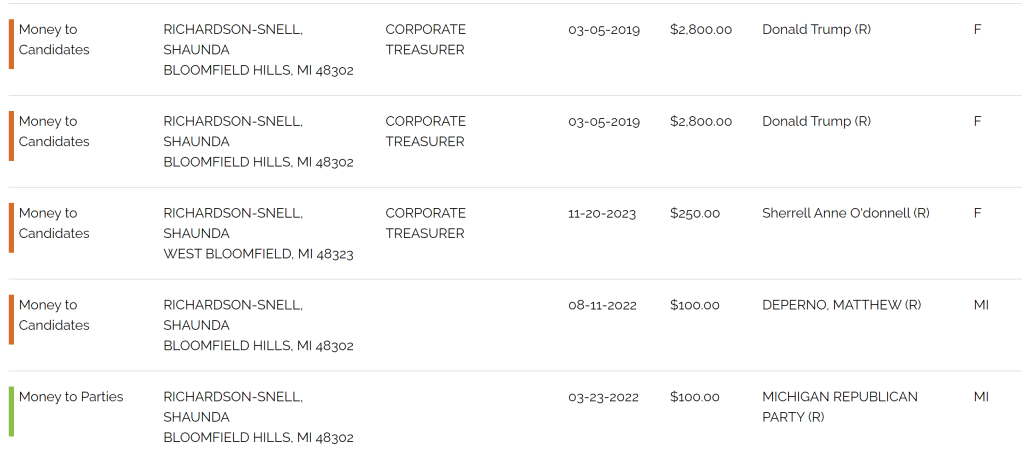
But here’s a thing about her that possibly serves as an explainer for the Board’s actions: thousands of dollars in political contributions to Donald Trump, among others of similar ideologies.
Political contributions aren’t disqualifying, of course. I live in Flint now, which is a Democratic stronghold. I also grew up in rural Lapeer. As a journalist, I’ve covered and had good relationships with elected officials of all backgrounds. But here’s why Trump, in particular, is a red flag in higher education: he has an ideology that seems intent on dismantling it. J.D. Vance, his running mate, once said “college professors are the enemy.” So it’s understandable that a new college president who has supported that ideology through her donations may cause some angst among the dedicated professors who now find themselves working for her.
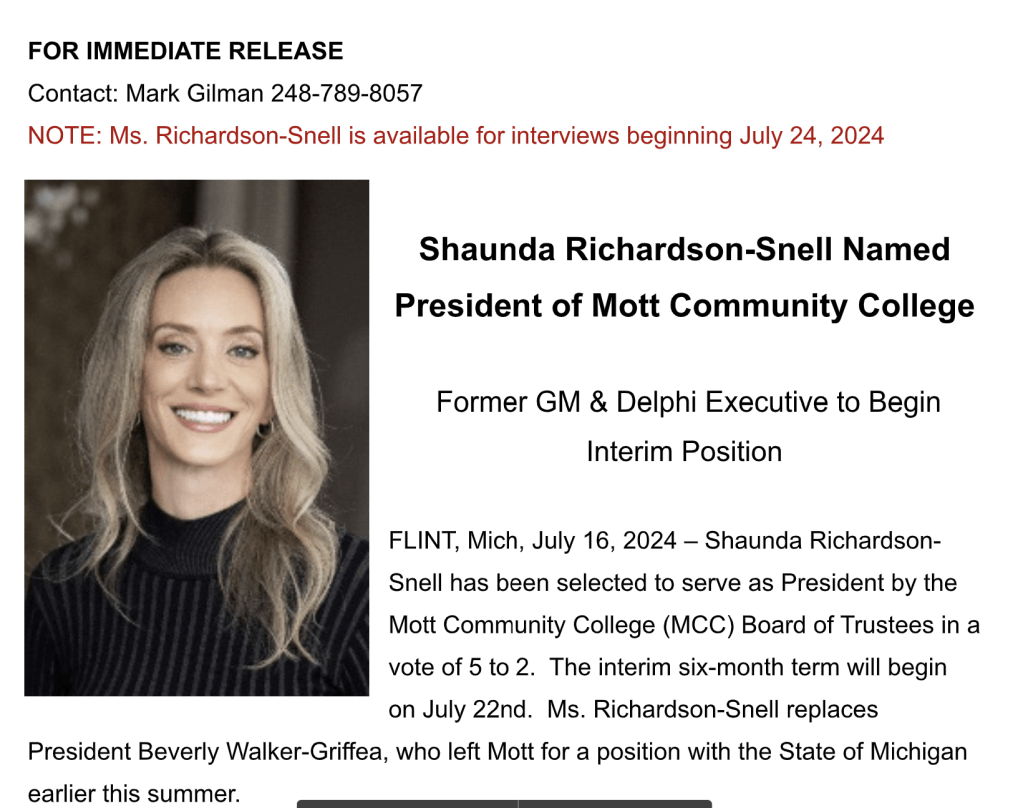
But that’s not the only red flag. Richardson-Snell used her own personal P.R. person for the press release announcing her hiring by Mott. Mark Gilman, who sent out her release, also writes for the Epoch Times. For those unfamiliar, the Epoch Times is a mysteriously funded, Qanon and other conspiracies-adjacentmisinformation factory. It should go without saying, but the president of a college, which is full of faculty who try to teach students how to decipher good sources of information from bad ones, working with someone who writes for perhaps the most notorious producer of misinformation is … problematic.
While we’re on the topic of optics, this isn’t necessarily a political point, but according to information shared by Mott Trustee Michael Freeman, Richardson-Snell used Artificial Intelligence to write her introductory letter to campus. Again, there’s nothing that is necessarily disqualifying about that, but 1., it seems a little lazy to farm out your first impression to the campus you are now leading; and 2., in a higher education environment where faculty are increasingly fighting the many ways AI has increased cheating and corner-cutting in classes, it certainly sends a questionable message when the interim president herself uses it to write a simple letter.
Board Actions
Walker-Griffea is an accomplished and successful higher education leader. She is also a Black woman. Jason Wilson, the candidate favored by faculty and staff to serve as interim president while a permanent replacement is found, is a Black man. When the interim position was originally posted, and the board lowered the education requirements seemingly helping their preferred candidate, it may have been purely coincidental that lowering that requirement benefitted a white candidate over Wilson.
But when that knowledge is combined with this board’s previous hostilitytoward diversity, equity, and inclusion efforts on campus implemented by Walker-Griffea and her team, it certainly becomes worthy of questioning their intention. The board itself has no Black members, leading a college located in a city that is 56 percent Black.
Much like Richardson-Snell’s choice of PR person, the attorney chose by Wolcott, Couch, and Daly during a hearing on recall language I submitted on the three of them in July also gives clues to their extreme political views. Dianne Cotter represented them at the hearing, and has herself advocated for positions that are not in line with Mott’s values. In response to the Michigan Supreme Court adopting language that respected the gender identity of attorneys and parties in front of courts, Cotter had the following public comment:
Speaking of “confounding the English language,” Ms. Cotter’s double spaces between sentences and aggressive use of hyphens is certainly assaulting on the English language. Cotter, who used to be an attorney for disgraced former Michigan GOP chair Kristina Karamo (recently seen being kicked out of her own party’s convention when it was held in Flint last month), has now been hired into a staff role as Wolcott’s secretary.
Out-of-touch (I can use hyphens too) people like Cotter and the board members she represents are not equipped to make decisions that impact current and future students at Mott. I’ve taught transgender students at Mott. I’ve taught nonbinary students. I’ve taught students of many different ages, religions, races, income levels, and sexualities. Their experiences are valid, they enrich classroom environments, and they should ALL be protected on campus. The currently elected board, and the interim president they selected, have repeatedly shown themselves to be ill-equipped for and openly hostile toward this important work.
Wolcott is also deceitful in other political pursuits. Currently, she’s a candidate for the Genesee County Commission in Davison, as a Democrat. Despite there being no evidence she’s ever been a Democrat. The Genesee County GOP donated $1,000 to her campaign for Mott’s board in 2022. Her son, Matthew Smith, is the tie-WEARING former chair of the Genesee County Republican Party. He received probation in 2022 “after pleading guilty to malicious use of a telephone for making a harassing phone call during which his victim says he threatened to kill her dogs,” according to MLive. He’s also personally railed against “critical race theory” in Davison, Michigan, a college-level concept that has never formally been a part of curriculum in … DAVISON! (Sidenote, just to prove the point of this blog post isn’t to be overtly partisan, EVERYONE in Davison should vote for Republican Brian Flewelling over Wolcott for County Commission, because at least Flewelling seems transparent).
The larger point here, other than itemizing who these people are, is that this chaos is actually strategic. This is a group of people with grievances who are attempting to ruin Mott Community College from within. And it isn’t even particularly tied to a political party. This can’t even be called fiscal conservatism or “running the college like a business” as Swanson once put it. This board has wasted incredible amounts of money with its poor leadership, overreach, and overall inability to govern.
They avoid transparency because they know their ideas are unpopular. They continuously exhibit an arrogant belief that those ideas can and will be pushed through and implemented because not enough people are paying attention to the Board’s actions. People, particularly students, are inclusive. My colleagues and I see it and have seen it for years. A rogue board that has been hijacked is jeopardizing the education of current and future students. These elected officials are specifically trying to further their own power, influence, and unpopular ideologies. It might — and has, to be honest — work temporarily. But one thing I know about Flint, is that people here care. And they fight. People love Mott Community College too much to let this ugly vision for the college continue.
Matthew Miller of MLive wrote an in-depth story on former Mott Community College President Beverly Walker-Griffea’s departure that is worth a full read as it covers much of the amateurish governance this board has displayed over the past year plus. This quote in particular from Trustee Art Reyes was good to see, as it validates the outright bullying many of us witnessed from Chair Andy Everman toward Walker-Griffea near the end of her tenure:
“We never should have been in the position that we were in,” said Trustee Art Reyes, “but we got a chairman who was openly disrespectful to the president and a majority of the board who did not support her nor stand up to the chair.”
The story is also full of highly questionable financial decisions, which shows this board’s whole “we’re gonna run it like a business” ethos is absurd.
But this Everman story that Miller relayed from Trustees Reyes and Michael Freeman and former Trustee Anne Figueroa is particularly disgusting.
Freeman, Reyes and former Mott Trustee Anne Figueroa all described an incident that occurred in a meeting of the Board’s Finance Committee in 2019, shortly after voters had returned Everman to the Board.
Walker-Griffea had been responding to a question, Figueroa said, and Everman took exception to the way she responded.
“He goes, ‘You need to call me “sir,”’” said Figueroa, who said she was seated next to Walker-Griffea at the meeting. “He led with that. And the rest of us kind of gasped.”
At a Board retreat that December, other trustees “basically told him, ‘This was wrong. You need to apologize to her.” He never apologized,” Freeman said.
Everman doesn’t recall asking Walker-Griffea to call him “sir.”
“Is there a video recording so I can hear myself saying this,?” he said. “Because I don’t remember this.”
The Board of Trustees at Mott Community College recently caused an uproar among faculty, staff and community members when they voted to hire an interim president without higher ed experience.
Critics see the move as the last straw in a series of questionable decisions since the board of the college in Flint, Mich., partly changed over in January 2023. They say trustees have been mired in drama and infighting for over a year, regularly holding fractious, multi-hour board meetings. Some employees worry the dysfunction could put the college’s accreditation at risk.
Dozens of students, faculty, staff, and community members raised public objections to the lack of transparency in the Board of Trustees’ hiring process for interim president Shaunda Richardson-Snell, who has no higher education experience.
At its meeting on July 15, 2024, the board approved Richardson-Snell’s contract without any board member publicly expressing why they felt she was better qualified than three other finalists with significant experience in higher education administration. But in truly shady fashion, once they realized there was a room full of constituents dissatisfied with their process, they voted to move public comment on the contract approval until AFTER they’d already approved Richardson-Snell’s contract despite public comment initially being listed before on the published agenda.
As soon as the contract was approved, Richardson-Snell immediately left the meeting. But she said in an interview with Kate Stockrahm of East Village Magazine that her leaving shouldn’t be a reflection of hear leadership style:
Richardson-Snell noted that she had wanted to stay for public comments, but her lawyer and representative had advised her against doing so.
“I argued with both the attorney and him [my representative],” she said. “And they insisted, and I said, ‘I do not want my team to think that I will ever walk out on them.’… That is not me. I do not leave my team.”
In that same interview, Richardson-Snell also seemed to express dismay at why so many were upset by her hiring:
“I was surprised because it showed me they clearly didn’t know me,” the incoming MCC interim president said in an exclusive interview on July 16. “It was really unfortunate that more time and care wasn’t taken to get an understanding of what I bring to the table before making those just, you know, those disparaging comments.”
Those comments should honestly be directed at the board who hired her. They provided zero explanation for why they thought the candidate whose experience was an outlier compared to similar roles was the best fit for Mott. They’ve provided zero specifics for what stands out about her background and makes her a superior candidate despite her clear lack of experience in this industry. They’ve provided zero rationale for why they thought the other strong candidates were not the right fits. They’ve provided zero public information for how they evaluated or scored each candidate’s strengths and weaknesses. In short, the board lacks accountability and transparency, and if Richardson-Snell is frustrated by the reaction to her hiring, she should take that up with the College’s trustees.
The moral of the story here is that the HLC doesn’t play when the academic staff at a higher education institution doesn’t take its marching orders from someone who isn’t qualified to lead a college or university academically.
Lowering academic qualifications for the role, hiring an unqualified leader, bringing in a President whose career has focused on money rather than teaching and learning – all create a strong basis for concern at the HLC. Those concerns will focus on the qualifications of the school’s leadership, the lack of leadership by the Board of Trustees, the lack of support from the faculty and more importantly, the leader’s inability to support the faculty in academic matters.

 Mott CC Recall
