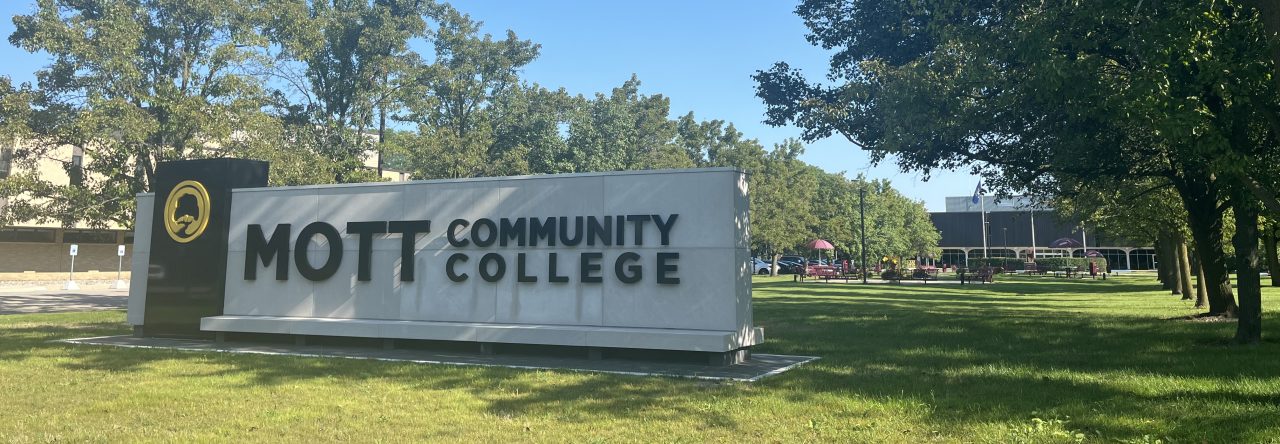
Mott’s Board of Trustees meetings have long been chaotic, poorly-run, and contentious, so much so that all of those things seem to be by design. But a set of two special meetings on Dec. 2 — one at 10 a.m. and one at 5:30 p.m. — proved particularly disorienting and stressful for those in attendance or watching online and even for some of the participants. I’m never really at a loss for words, but I’m struggling with where to even start here. So I’m going to fall back on the old journalism inverted pyramid and try to just go in order of importance.
Board Attorney Provides Legal Opinion About Conflict of Interest, Then Withdraws as Counsel
In the earlier special meeting, one of the agenda items for board consideration was “Retention of Counsel for Limited Scope Employment Related to Contract Offer to Interim President Shaunda Richardson-Snell.” Which begged the question … why isn’t the board’s attorney negotiating the employment contract with Richardson-Snell?
That question began to get answered, at least partially, during the early meeting. Board Chair Andy Everman noted it was necessary because William Brickley, the board’s attorney, had declined to participate in the contract negotiation for Richardson-Snell’s permanent role. Trustees John Daly, Michael Freeman, and Art Reyes alluded to some sort of conflict of interest complaint against Trustee Janet Couch, which Everman quickly shut down and said could not be discussed publicly.
In the second meeting, those two issues would get an explanation from Brickley himself. Initially, the board had a motion to go into closed session to discuss a memo Brickley had written and the conflict of interest allegation. However, that motion failed. A new motion to waive the board’s attorney-client privilege and have the memo read publicly passed.
Which … as a citizen, I’m glad it was read publicly. As a rational human being, I can’t for the life of me figure out why the board wouldn’t use its option to discuss a personnel issue in private with their attorney before airing everything out in public. But I’m not sure trying to look at any of their decisions through a rational lens will do me any good.
The meeting embedded above is worth watching in its entirety if you can stomach it, just to get a good feel for this board majority’s overall toxic behavior and dishonesty. But Brickley’s section beginning at 1:55 is particularly important to watch. You can read his full memorandum here.
In short, Shaunda Richardson-Snell used Trustee Janet Couch’s daughter as her real estate agent when she bought a home in Genesee County, which in Brickley’s legal opinion is a violation of the board’s own conflict of interest policy. From the document:
Ms. Couch did not believe a conflict of interest existed as she did not see any money from Mott going to her daughter or her real estate firm. I advised that I believe a potential conflict of interest existed under the policy despite her feeling to the contrary.
I just want to note here that Richardson-Snell’s compensation package was extremely generous for a permanent president, let alone an interim. It included a $15,000 stipend for moving expenses (I believe she relocated from Oakland to Genesee County; also, relocating for an interim job is pretty brazen unless there’s some sort of wink-wink agreement that you’ll be installed in the permanent role), so Couch’s contention that she “did not see any money from Mott going to her daughter or her real estate firm” is absurd. What else would you use some or all of your relocation expenses for if not to pay a realtor?
Brickley also made Everman aware of the possibility of a conflict of interest and advised that it should be disclosed. He also advised that, if the board was going to put hiring Richardson-Snell permanently on its agenda, then the disclosure of Couch’s potential conflict should also be added. At the board’s Nov. 18 meeting, not only was Couch’s conflict not disclosed to the board or public, Couch herself made the motion to hire Richardson-Snell. That time, the motion to hire her failed 4-3, with Couch storming out after the vote.
A week later, the motion to hire Snell was revisited and snuck onto the agenda during the continuation of the previous week’s meeting. Brickley wasn’t in attendance, but prior to the meeting Trustee Jeff Swanson let Brickley know that the motion could be revisited and Brickley advised that the conflict should be disclosed to the board and Couch should abstain from voting. Another attorney with Brickley’s firm, Michael John, slid Everman a note when the motion came back up reminding him it should be disclosed, and he was also ignored. This time, the motion passed 4-3.
So, what does all of that mean for day-to-day operations of Mott? Here’s a portion of Brickley’s opinion (but again, you should read the entire thing):
I furthermore advised that if hired there could be legal challenges to the hiring which if brought would be difficult to defend. Furthermore I advised that any decision made by Ms. Richardson Snell, if she were the president, could be challenged and possibly overturned by a court if it was found she was not properly hired for the position.
…
Therefore under your very broad policy a full disclosure should have been made, Ms. Couch should not have brought the motion and she should not have voted on the motion. Without Ms. Couch’s vote the motion would have been 3 to 3 and would have failed. On that basis I believe according to Michigan law the decision is void and a court of law would so rule. This could subject the college to litigation and possible void any decisions made by Ms. Richardson Snell.
Brickley’s memo concludes with him withdrawing as Mott’s attorney, stating in part, “I believe the trust relationship necessary to act effectively has been lost.”
Differing Legal Opinion
A lawyer from another firm, I believe Trustee Wendy Wolcott said the firm was ‘Butzel,’ prior to the attorney speaking, had a rebuttal. It is unclear when that firm was asked to prepare a response, but the lack of preparation showed in the back and forth she has with Brickley in the video above.
I can’t do it justice in a recap, but essentially the attorney endorses Everman’s position that he did not need to disclose Couch’s potential conflict of interest because he believes board policy allows him to investigate it himself, which he says he did, and concluded that there was no conflict.
Brickley pokes several holes in that argument and throws out an iconic “OK, but who has the legal license?” line during a back-and-forth about Everman’s conclusion that there was no conflict of interest. The entire interaction is worth watching, and begins at about the 2:20 mark in the video above.
And also … if anyone from Butzel does its homework on Mott’s board, they’ll see that the board fired its previous board attorney under dubious circumstances, and now Brickley, their hand-picked successor, has left and cited a lack of trust as a reason approximately a year after he was hired by the board. They’re clearly a problematic client, but that’s none of by business.
Richardson-Snell Asks Board to Use a Search Firm, Board Still Declines
After Brickley read his memo, Richardson-Snell asked to address the board. Beginning at about the 2:08 mark, Richardson-Snell is questioned by Trustee Michael Freeman about how much she knew about the potential conflict of interest. She initially denies having a “conversation” with Brickley about it, before Brickley interjects to say they did have a text message exchange in which she asked for the board’s conflict of interest policy and he provided it.
Richardson-Snell then asks to address the board. She says she was unaware of the behind-the-scenes maneuvering of Everman to keep the disclosure from becoming public, and clearly tries to distance herself from Everman.
Richardson-Snell then describes herself as a person of “process and transparency” and says, “As I listen to input from faculty, staff, and the community, I agree. I agree that a process should be followed.” She notes that she has “never once asked to be appointed” to the permanent position and continues, “I would also recommend to the board that it resume an appropriate search process and I will take the lead right now and ask that the board make the decision to do a national search.”
After listening to the hastily thrown together legal opinion by the Butzel attorney that essentially parroted Everman’s viewpoint, the board ignored both Brickley’s opinion and Richardson-Snell’s own instruction that they do a national search and once again affirmed their decision 4-3 (Everman, Couch, Wolcott, Swanson) to offer the permanent president position to Richardson-Snell without following a standard search process or considering any other candidates. Swanson equivocated a little bit and tried to abstain so he could get more legal opinions, but voted ‘no’ when he was informed he couldn’t abstain.
I’m really speechless after watching it. This is a board majority that is committed to publicly embarrassing itself if nothing else. I have no idea what is next, but based on the conversation at last night’s meeting the decision is likely to lead to costly legal challenges that take resources away from the college’s core mission. Which has been par for the course for this reckless group for the past two years despite their “run it like a business” stance.
A Few Other Meeting Notes
This is already a ridiculously long recap, but between two meetings, a lot of other stuff happened worth mentioning.
- Everman began the evening meeting trying to read some sort of statement defending Couch from conflict of interest allegations before they’d even been made public. He was cut off, as it was not on the agenda, and a 4-3 vote prevented him from continuing to read it. Wolcott, who usually reliably votes with Everman, voted against allowing him to continue with the remarks. Everman glared directly at her and said, “you happy with that vote?” I just have to say … I have no idea why Swanson and Wolcott put up with Everman’s childish antics. It just doesn’t seem worth it, especially considering he’s lame duck and his term only lasts a few more weeks (sorry, I love adding reminders that Andy convincingly lost his re-election bid, I’m petty like that).
- The morning meeting began with Everman trying to prevent Perci Whitmore from addressing the board because his comments weren’t specific enough to the agenda (this would be a running theme through both meetings of Everman trying to silence commenters). Here’s Perci’s response to how he was treated if you’re interested.
- Poor attempts to shut the public out of speaking occurred frequently. During the evening meeting, a police officer and military veteran opened public comment with criticisms of the board, and Everman threatened to have him removed from the meeting. Everman also threatened to have another audience member who spoke, a Mott alumnus, removed. She left on her own so Everman would stop badgering the Mott Police Chief to throw her out. Everman also cut off community member Paul Jordan for referencing Richardson-Snell’s ties to a Christian nationalist pastor.
- Also related to public comment, Wolcott in the board’s previous meeting mentioned a “silent majority” of people at the college who are supportive of hiring Richardson-Snell. That silent majority was extra silent at this meeting, as not a single speaker that I can recall at either meeting spoke in favor of the board’s actions. Unless we count the final unhinged speaker who ranted about land grabs or something, Mott’s graduation rate, and other incoherent things (and incidentally left the meeting chatting with Wolcott).
- In both meetings, it was mentioned that Everman believed he needed to be notified “in writing” of a potential conflict of interest in order to bring it forward to the entire board. In the morning session, Daly said that he had emailed a document to him. Everman proudly boasted that he “never” checks email and doesn’t trust it. Which is exactly what you want from a public servant, someone who is too paranoid to use what is either the first or second most common present form of communication.
- The morning meeting also included an agenda item to allow Richardson-Snell as interim president to sign some time-sensitive documents related to the Culinary Arts building downtown Flint, which was originally redeveloped in partnership with Uptown Reinvestment Corporation. Per the agreement, the college will eventually take ownership of the building from Uptown. If anyone is interested in redevelopment inner-workings, you can check out that part of the meeting for the discussion. But the funniest section was when Everman went on a rant questioning the structural integrity of the building, claiming it has a mold problem, and claiming it has flooding issues. I have no idea if any of those things are true, but the interaction with Mott CFO Larry Gawthorp in which Gawthorp states that he isn’t aware of those issues and that the structural engineering reports say otherwise is a pretty classic Everman behaving like an expert on everything moment.
What’s Next?
I assume there will at least be attempted legal challenges related to the board’s recent decisions. I don’t really know what that process looks like, who will be involved, or what impact it will have on the college, other than continued avoidable cost and turmoil for the students, faculty, and staff who have to keep the college’s actual core business moving forward despite a cartoonishly inept board majority causing constant distractions.
I do know this, though: the right thing to do is for Couch, Everman, Swanson, and Richardson-Snell to resign. Couch, Everman, and Swanson all knew about the conflict of interest issue, all were advised by the board’s legal counsel of how it should be handled, and all of them chose to ignore that advice. Even if Everman is right and a court decides there was no conflict, not disclosing it gives the impression of an attempt to cover it up. The transparent and responsible thing to do is disclose it, be honest about it, and follow legal precedents for how to address it.
Richardson-Snell has been done no favors by this board. If their goal was to install her as president, they still could’ve done so by following a transparent search process in which other candidates were considered, input from campus was considered, and finalists were given a chance to talk directly to students, faculty, and staff in forums. If they followed that process, and Richardson-Snell still emerged from it as their choice, I may not have agreed with the decision, but it was still a process, it still collected input, and it still would’ve given campus the opportunity learn more about what her vision actually is for the college and why the board feels she’s the best fit for what Mott needs. I don’t have to like the things elected officials do as long as they do them with integrity and transparency.
I want to be unequivocal when I say that none of the things this board has done are Richardson-Snell’s fault. I don’t believe she’s a qualified candidate for the position, but I do also believe that she was thrust into an impossible situation and set up to fail because of a board majority that clearly believes four people alone are responsible for making all decisions about the college. I don’t blame Richardson-Snell for the board’s actions, and I have not heard from or interacted with any colleagues who do.
She should still resign. This potential conflict of interest with her and Couch further supports the feelings that many have that this search for a president has been fixed and done in bad faith from the start. The right thing to do is remove herself as president and distance herself from how this board has conducted its business.
 Mott CC Recall