Buried deep within the packet of materials for the Nov. 18 meeting of the Mott Community College of Board of Trustees was an enrollment report that was bleak, to say the least.
For some context, like nearly all college’s nationwide, enrollment dropped at Mott during the pandemic. But under Mott’s previous president, Beverly Walker-Griffea, the college’s enrollment had stabilized and actually begun to tick back up on a modest but upward trajectory over the last year or so of her tenure. On page 50 of the packet, you can see that trend had continued into the fall of 2024, with a nearly 4 percent increase over the previous year:

Recruiting for the fall class mostly wraps up by late summer. The board appointed an outside hire, Shaunda Richardson-Snell, as interim president during that time. Her 6-month contract began on July 22.
The primary role of any interim president at any college is to stabilize core business while a permanent president is selected. This is typically why colleges appoint interim presidents from within, so that it is someone familiar enough with the college’s departments and operations to temporarily keep things steady during a presidential search and create a seamless transition plan for whoever is ultimately hired in that role. In Richardson-Snell’s case, she was unfamiliar with Mott’s internal workings, and also had no higher education administration or even teaching experience.
There isn’t a business component of a college or university that is more “core” than enrollment, and the numbers for the upcoming winter semester are alarming:
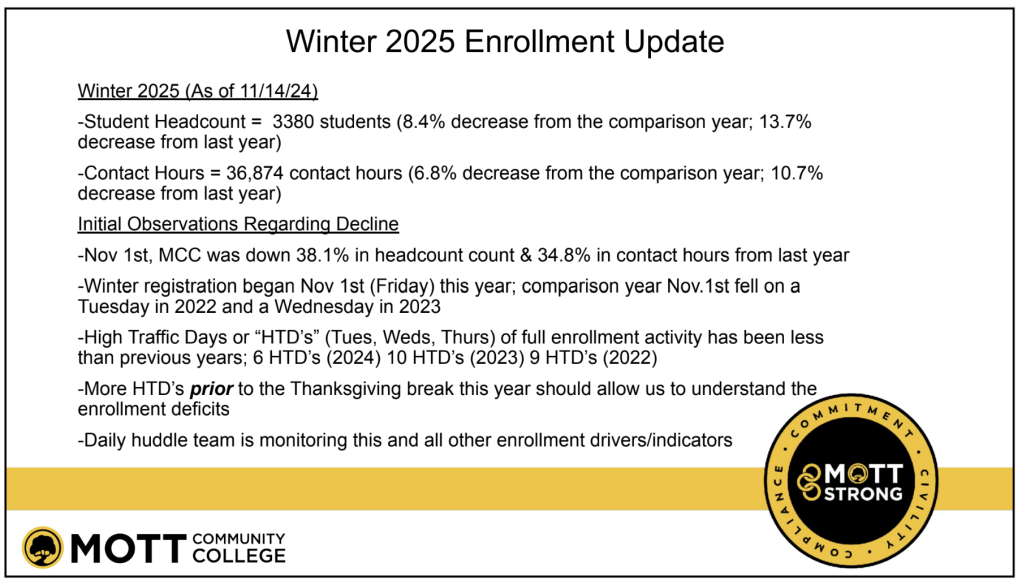
A nearly 14 percent drop from last winter is going to have a negative impact on the college.
Enrollment and admissions at any college is complicated. There are often good explanations or reasons for peaks and valleys in the admissions cycle. However, the falling winter enrollment has not been addressed in any way at any recent Mott board meetings. It would be appropriate for a president of a college to be able to articulate a plan to account for such a dramatic drop, and Richardson-Snell has yet to be asked by the board what her plan is. Because this week’s board meeting was repeatedly derailed by a board chair who was more focused on his personal grievances than on the college, the board didn’t even get to a public discussion of the report.
On top of that, the board nearly made Richardson-Snell the permanent president during that same meeting without conducting the national search for additional candidates that they’d agreed to do at their October meeting. At an absolute bare minimum, it would be nice to know that the person they’re trying to hire into this position permanently has a plan to address a sharp decline in incoming students.
Upon her hiring, the only board member who offered any explanation for what stood out about Richardson-Snell vs. other candidates for the interim position was Jeff Swanson, who expressed his belief in her business background. He said he’d like to see the college run “more like a business.”
Since that time, the board of trustees has racked up numerous legal fees (and if you watch the Nov. 18 meeting, they publicly rely on their legal counsel more than any public board I have seen in the nearly 20 years I’ve worked on and off in local journalism). They have hired a secretary for the board’s secretary. They have resisted multiple attempts to conduct an actual fair search for candidates for the position, something any well-run business or organization should want to do. And now, their preferred candidate is overseeing a precipitous drop in the college’s core business that will undoubtedly impact jobs and resources available for students if it continues without a mitigation plan.
None of those things represent “running the college like a business.” But they do represent continued irresponsibility and failure of leadership of this Board of Trustees.
 Mott CC Recall